8×8 Board
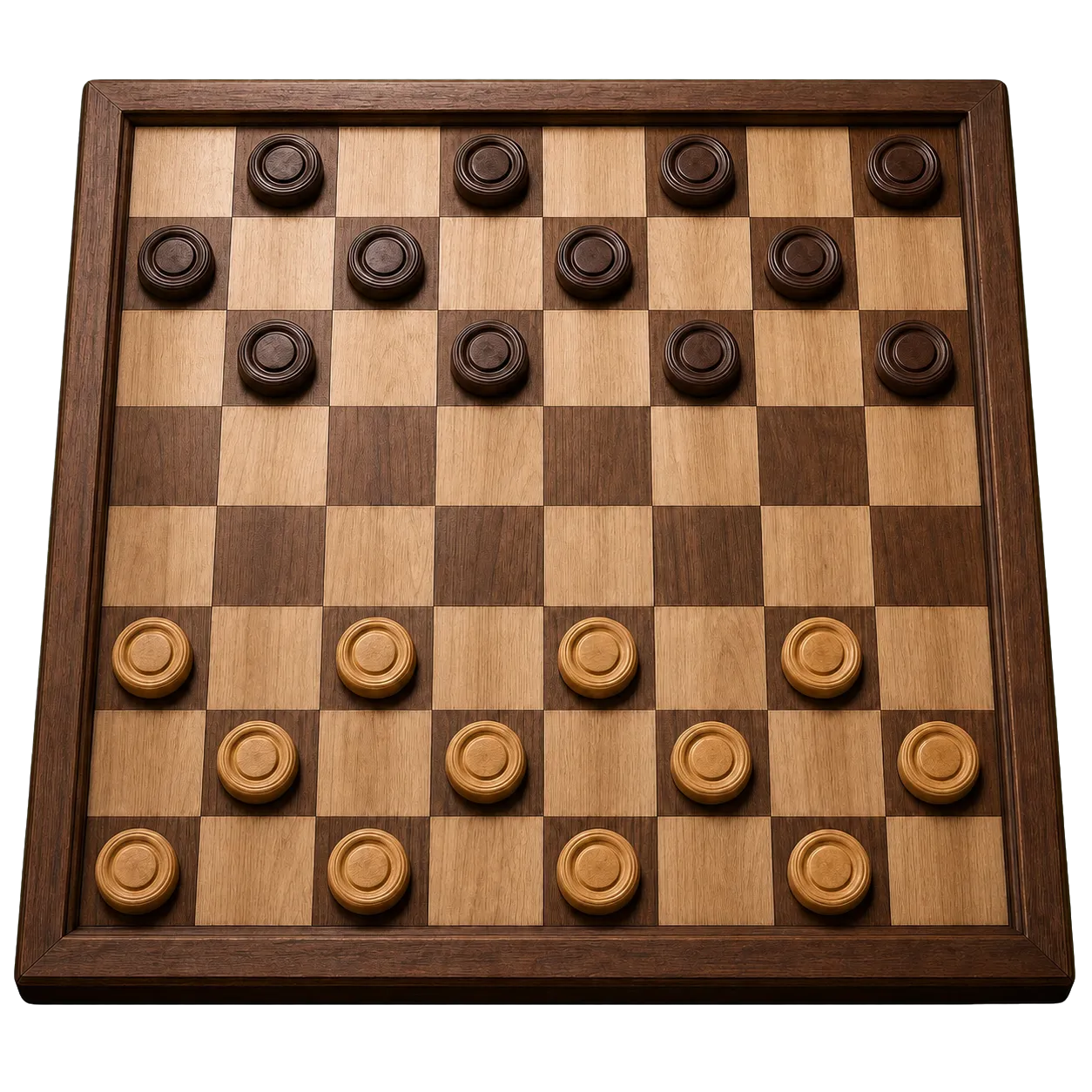
Each player starts with 12 men on the dark squares of the three rows nearest them. White moves first.
Discover Portugal’s distinctive 8×8 draughts game: men move and capture forward, kings fly along open diagonals, and every capture is judged first by quantity and then by quality.
Familiar diagonal movement meets a strict, layered capture system.
Each player starts with 12 men on the dark squares of the three rows nearest them. White moves first.
Men move one square diagonally forward and also capture forward only, making tempo and structure especially important.
Kings move any clear distance diagonally forward or backward and can land beyond a captured piece at range.
If more than one capture is available, the route that takes the greatest number of pieces is compulsory.
When routes take the same number of pieces, the player must choose the route that captures the most kings.
Captured pieces remain on the board as blockers until the entire capture sequence has been completed.
Learn the official essentials before starting your first game.
Board: Play takes place on the 32 dark squares of an 8×8 board. The long dark diagonal begins on each player’s right.
Setup: Each side has 12 men arranged across the first three rows. The player with the white pieces makes the opening move.
Goal: Win by capturing every opposing piece or leaving the opponent without a legal move.
Quiet move: A man advances one empty square diagonally forward. It cannot move backward.
Capture: A man jumps forward over an adjacent enemy into the empty square immediately beyond. If another legal capture follows, the sequence must continue.
Promotion: A man reaching the opponent’s back rank becomes a king. Its move ends there, and it receives king powers after the opponent’s reply.
Flying move: A king can travel any number of empty squares along a diagonal in either direction.
Long capture: A king jumps an opposing piece on the same diagonal and may land on a legal empty square beyond it.
Changing direction: During a multiple capture, a king can turn onto another diagonal. It cannot pass over the same captured piece twice.
Capture first: A quiet move is illegal whenever any capture exists.
Quantity first: Compare complete routes and select one that captures the maximum number of pieces.
Quality second: If the totals are equal, select the route that captures more kings. If quantity and quality are both equal, the player may choose.
Remove afterward: Pieces taken in a multiple capture stay in place until the moving piece reaches its final landing square.
Victory: The game is won by taking all opposing pieces, immobilizing the opponent, or accepting a resignation.
Draws: The official rules cover repeated positions and move limits for qualifying endgames, including the traditional 20-move rule.
Both use 12 pieces on an 8×8 board, but their capture logic is not the same.
Men move and capture forward only. If capture totals tie, the quality law requires the route that takes more kings. Captured pieces are removed after the full sequence.
Men can capture both forward and backward. Capture priority is based on the greatest number of pieces, without the Portuguese quality-law tiebreak.
A popular social game developed into an organized national discipline.
Portuguese Draughts, traditionally called damas clássicas, has long been played in homes, cafés, clubs, and community associations. Its compact board and forcing capture rules make it easy to begin and rich enough for lifelong study.
An initial attempt to establish a Portuguese federation was made in 1954. The Federação Portuguesa de Damas was formally organized in 1980, after which national championships and the Portuguese Cup became regular official competitions.
In its early years, the federation focused chiefly on the 64-square national variant. Portuguese Draughts remains a distinct rules tradition alongside the country’s 100-square international competitions.
Today the game combines club competition, national rankings, coaching, and online play. Digital boards make its distinctive quantity and quality laws accessible to players far beyond Portugal.
Build positions that work with compulsory captures, not against them.
Forward-only men cannot repair a weakness by retreating. Maintain diagonal support, avoid isolated pieces, and preserve routes toward promotion.
Never stop after spotting the first jump. Count the full route, then compare the number of kings captured whenever two routes take equal totals.
Because captured pieces remain until the move ends, an apparently open diagonal may still be closed. Use that deferred removal to limit an enemy king’s route.
The long diagonal known as the Rio is a major highway for flying kings. Control of it expands mobility and matters in classic king endgames.
Compare Portuguese rules with related games from around the world.
An 8×8 game with international-style movement and majority capture.
The world championship game played with 20 pieces each on 10×10.
Short-range kings and one of the strictest capture-priority systems.
A fast 8×8 variant with backward captures and flying kings.
Put the quantity and quality laws into practice against the computer. It is free and starts instantly.
Play Portuguese Draughts Free →