Play Italian Checkers Online
The classic checkers variant played in Italy: 12 pieces per player on an 8×8 board, short-range kings, and particularly strict capture priorities. Learn the rules, sharpen your strategy, and discover the competitive tradition of Italian Checkers.



What Makes Italian Checkers Unique?
Discover the features that set the Italian variant apart
8×8 Board
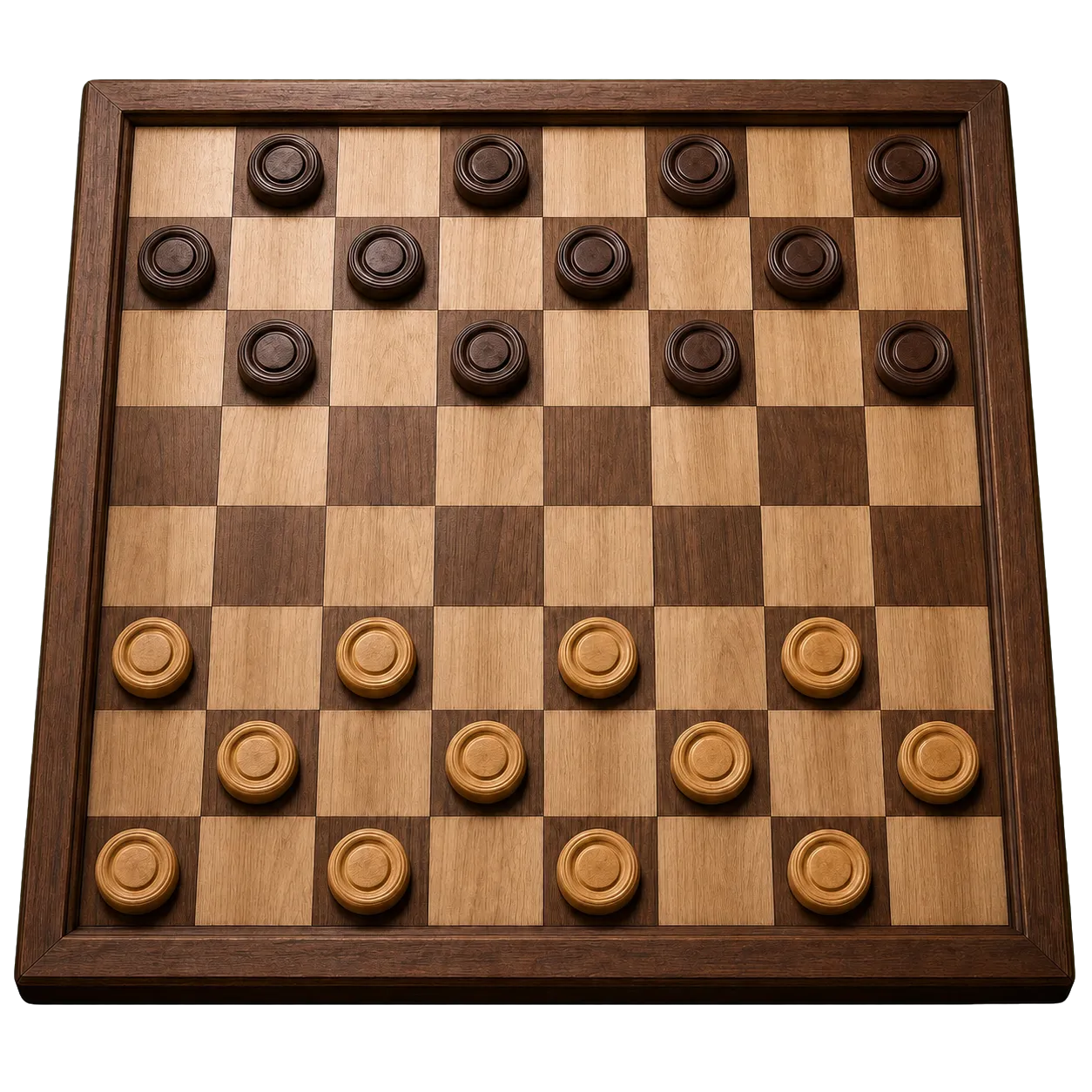
The game uses the 32 dark squares of an 8×8 board. Each player starts with 12 pieces arranged on the first three rows.
Short-Range Kings
A king moves only one diagonal square forward or backward. When capturing, it also lands on the first empty square beyond the captured piece.
Mandatory Capture
When a capture is available, it must be made. Multiple captures continue within the same turn until the sequence is complete.
Capture Priorities
You cannot always choose freely: the number of pieces, the rank of the capturing piece, and the value of captured pieces all matter.
Dark Corner on the Right
The board is oriented with the dark corner square, known in Italian as the cantone, on each player's right.
Competitive Heritage
The Italian Checkers Federation (Federazione Italiana Dama), founded in 1924, organizes championships, youth programs, and tournaments across the country.
Italian Checkers Rules
Learn how to play step by step
Initial Setup
Board: Italian Checkers is played on a 64-square board, but only the 32 dark squares are used. The dark corner square, called the cantone, is placed at the lower right.
Starting Position: Each player begins with 12 pieces placed on the dark squares of the three rows nearest their side.
First Move: White moves first, and the players then alternate turns.
Piece Movement
Men: A man moves one diagonal square forward onto an empty dark square. It cannot move backward.
Promotion: When a man reaches the opponent's back rank, it is promoted to a king. If it arrives there during a capture, the sequence ends and the turn passes to the opponent.
Kings: A king moves one diagonal square either forward or backward. Unlike kings in International or Russian Checkers, it cannot travel freely along a long diagonal.
Capture Rules
Mandatory Capture: If a player can capture, they must do so. A non-capturing move is not allowed when a legal capture exists.
How to Capture: A piece jumps diagonally over an adjacent opposing piece and lands on the first empty square beyond it. The jumped piece is removed.
Multiple Capture: If another capture is available from the landing square, the same piece must continue. The entire sequence counts as one move.
Men and Kings: Men capture only forward and cannot capture kings. Kings capture both forward and backward and may take either men or kings.
Capture Priority: When several captures are available, choose the sequence that takes the most pieces; if tied, capture with the higher-ranked piece, then take the greatest number of higher-ranked pieces, and finally choose the line that meets the strongest piece earliest.
Winning and Drawing
Victory: You win when your opponent:
- has no pieces left on the board;
- still has pieces but cannot make a legal move;
- resigns the game.
Draw: Players may agree to a draw. Official rules also provide for a count of 40 moves by the player who requests it; the count restarts whenever a man moves or a capture is made.
History of Italian Checkers
From a popular tradition to an organized mind sport
Ancient Roots and Growth in Italy
Board games with opposing pieces have very ancient roots. Across Europe, checkers developed over the centuries into several families of rules shaped by local traditions.
Italy developed its own 8×8 variant, recognizable by the dark corner on the right, short-range kings, and strict capture priorities.
Codifying the Rules
A Distinct Identity: The king's limited movement and the rule preventing a man from capturing a king clearly distinguish Italian Checkers from many other 64-square variants.
Capture Priorities: Quantity and rank criteria make forced combinations especially deep. A player must calculate not only where a capture is possible, but which capture the rules require.
Notation: The 32 active squares are numbered so players can record and study games, openings, and composed problems.
The Italian Checkers Federation
1924: The Federazione Italiana Dama (FID) was founded in Milan through the initiative of Luigi Franzioni. It has coordinated and promoted organized checkers in Italy ever since.
Competitive Play: Italian championships, regional tournaments, clubs, and technical training turned a widespread pastime into an organized discipline.
Sport Recognition: The FID operates among the sports disciplines associated with the Italian National Olympic Committee and oversees Italian Checkers as well as other variants.
Italian Checkers Today
Italian Checkers remains active in clubs, competitions, schools, and families. The simple equipment makes it easy to start, while the capture rules offer considerable depth for experienced players.
Online play now makes it possible to practice at any time, meet a variety of opponents, and review games to improve calculation and strategy.
Where Is Italian Checkers Played?
A variant deeply connected to Italian culture
Italy: The Center of the Tradition
Traditional Game: For generations, checkers has been played in homes, cafés, recreation clubs, and public squares. In Italy, the word dama often refers specifically to this variant.
Clubs and Regions: Associations and checkers clubs organize lessons and tournaments in many regions, bringing together beginners, young players, and experienced competitors.
Competitions: The federation calendar includes national, regional, and provincial championships as well as promotional and youth events.
Outside Italy
Italian Communities: Enthusiasts and communities connected to Italian culture also play the variant abroad.
Online Play: Digital platforms have removed geographic barriers and made Italian rules accessible to players worldwide.
International Comparison: Learning Italian Checkers also makes it easier to understand how English, Russian, Brazilian, and International Checkers differ.
Cultural and Educational Value
Italian Checkers combines tradition, learning, and social play:
- Logic: It trains players to evaluate alternatives, consequences, and forced sequences.
- Concentration: It teaches players to examine the entire board before moving.
- Social Play: It connects generations and different levels of experience.
- Accessibility: The basic rules are easy to learn and the equipment is simple.
- Depth: Openings, endgames, and combinations provide a lifetime of study.
Italian Checkers Strategy & Tactics
Practical principles for more accurate play
Opening Principles
Control the Center: Central pieces have more mobility and can support one another on both diagonals.
Develop with Purpose: Avoid advancing an isolated piece without considering the mandatory captures the new position may create.
Protect the Back Rank: Opening promotion squares too early may give your opponent a path to a king.
Keep Pieces Connected: Coordinated groups are harder to force and create better exchange opportunities.
Middle-Game Tactics
Use Mandatory Captures: Many combinations begin by offering a piece to force the opponent onto an unfavorable square.
Calculate Priorities: Before sacrificing, verify which sequence is truly compulsory according to the number and rank of the pieces.
Evaluate Exchanges: When ahead, reducing material can simplify the win; when behind, seek positions with tactical chances.
Prepare Promotion: A king is more mobile, but it does not dominate long diagonals in Italian Checkers, so it must be supported and placed accurately.
Endgame Technique
Count Tempi and Squares: With few pieces left, a single opposition move can decide whether a man is blocked or promoted.
Restrict Mobility: You can also win by blocking every opposing piece without capturing them all.
Stop Passed Men: Control the diagonals toward the back rank and use your king to force the man onto an unfavorable path.
Know the Draws: Not every material advantage is enough. Learn basic positions and remember the official move-count rule.
Typical Combinations
Multi-Capture Shots: Prepare a sequence that forces the opponent to capture and finish on the diagonal you want.
Sacrifices: Giving up a piece can open the way to a multiple capture, promotion, or decisive block.
Capture Rank: A king involved in the sequence can change the compulsory priority and make an otherwise illegal idea possible.
Calculation: Rebuild the position after every jump; in multiple captures, each landing square may open new continuations.
How to Improve
Play Regularly: Face opponents of different levels to recognize a wider range of strategic patterns.
Study Combinations: Practice forced captures and the four capture priorities of Italian Checkers.
Review Your Games: Find the first moment when you missed a threat, favorable exchange, or forced capture.
Learn Openings: Do more than memorize moves; understand the structures and endgames they produce.
Play Online: Use quick games to train pattern recognition and slower games to deepen calculation.
Other Checkers Variants
Discover rules and strategies from around the world
🇬🇧 English Draughts
Learn about the variant popular in the UK and Commonwealth, with short-range kings and free choice of capture.
🇷🇺 Russian Checkers
Compare Italian Checkers with the flying kings and backward captures of the Russian variant.
🇧🇷 Brazilian Checkers
An 8×8 variant with flying kings and rules inspired by International Checkers.
🌍 International Checkers
The 10×10 discipline used in world championships, with 20 pieces per player.
Ready to Play Italian Checkers?
Put the rules into practice and improve one game at a time
Play Italian Checkers Free →