Play Checkers Online
Checkers is a strategy game for two players, each starting with 12 pieces on an 8×8 board. Move diagonally, make compulsory jumps, and reach the far side to earn kings. Play checkers online for free, or explore the rules, history, and strategy of the classic game below. This guide covers American checkers, also known as English draughts.



What Makes Checkers a Game of Strategy?
A small set of rules creates a game of calculation, coordination, and carefully timed exchanges.
A Familiar 8×8 Board
American checkers uses the 32 dark squares of a standard checkerboard. Each side begins with the same number of pieces and the same movement rules. There are no different starting piece types to memorize: every piece begins as a man, and its position determines the opportunities and risks it faces.
Kings and Promotion
A man becomes a king by reaching the opposite end of the board. Kings can move and capture backward as well as forward, allowing them to defend vulnerable pieces and approach threats from different directions. Their short-range movement makes coordination important: a king has greater freedom, but it still needs a safe square to land on.
Compulsory Captures
A legal jump must be taken, even when the capture appears unfavorable. This makes sacrifice a central part of checkers. Offering one piece can force an opponent onto a square where a longer reply wins material. The challenge is to calculate the entire exchange before deciding whether the first capture is an opportunity or a trap.
Tactics and Position
A tactical combination produces an immediate result, such as winning a piece or reaching the king row. Positional play prepares those opportunities by improving mobility, supporting an advance, or restricting an opponent. Strong play combines both: a promising long-term plan is useful only if it survives the forcing moves available now.
A Game of Skill
Once the initial position is set, checkers has no dice, hidden cards, or random moves. Both players can see every piece. The information is shared, but interpreting it takes practice: a player must weigh immediate captures against future movement, recognize recurring patterns, and judge which exchanges lead to a favorable ending.
An Established Mind Sport
Checkers has an organized competitive tradition alongside casual play. The American Checker Federation, abbreviated ACF, supports the game in the United States, while the World Checkers/Draughts Federation oversees international competition under English rules. Tournament players study opening theory, record their games, and prepare for positions that demand precise calculation.
How to Play Checkers: Rules and Winning Conditions
These are the standard rules of American checkers. Agree on this rule set before starting, especially if you learned a different version at home.
The Board, Starting Position, and First Move
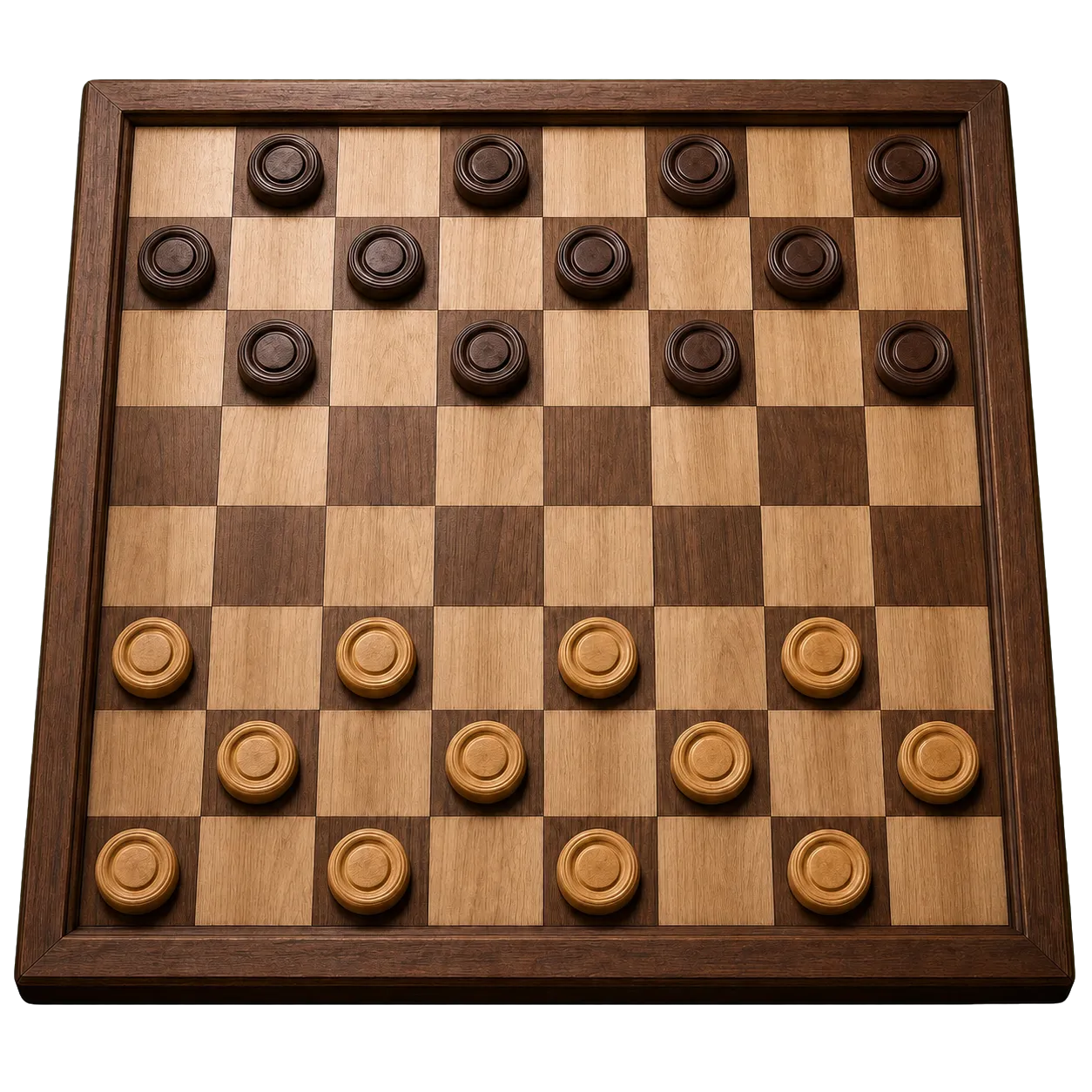
The Checkerboard: The board has eight rows and eight columns, with alternating light and dark squares. Only the 32 dark squares are used. Position it with a dark square at each player’s near-left corner. Because every move follows a diagonal, a piece remains on the dark squares throughout the game.
Starting Pieces: Each player places 12 uncrowned pieces, called men, on the dark squares of the three rows nearest them. The two middle rows remain empty, leaving space for the opening moves. One side uses dark pieces and the other light pieces. Colors vary between sets; a particular red, black, or white color combination is not essential.
Who Moves First: The dark side makes the first move, and players then alternate turns. In WCDF tournament sets, the dark pieces are red and the light pieces are white, so Red moves first. In Draughts.io’s English variant, the starting side is Black. A turn consists of one ordinary move or one complete capturing sequence; a player cannot pass.
Moving Men and Becoming a King
How a Man Moves: A man moves one square diagonally forward onto an empty square. Forward means toward the opponent’s starting rows. Men cannot move sideways, straight ahead, or backward. An ordinary move cannot land on an occupied square, and a piece cannot move through another piece. If a capture is available anywhere on your side, an ordinary move is not allowed.
Crowning a Piece: A man reaching the farthest row, called the king row, is promoted to a king. With a physical set, a second disc of the same color is commonly stacked on top to mark the change. Promotion ends that turn. This also applies when the man reaches the king row by jumping: it must stop and wait until its next turn before using a king’s backward movement.
How a King Moves: A king moves one empty square diagonally in any of the four directions. It may move backward, but it does not slide along an entire diagonal. This short-range king is a defining feature of American checkers. The word king describes a promoted checker, not a royal piece that must be protected from check; kings can be captured like other pieces.
Captures, Double Jumps, and Multiple Jumps
When a Jump Is Legal: A capture requires an opposing piece on an adjacent diagonal square and an empty landing square immediately beyond it. Your piece jumps over the opponent and lands two squares away along that diagonal. A man can make this jump only forward. The captured piece may be a man or a king; an uncrowned checker is fully entitled to capture an opposing king.
Capturing One Piece at a Time: Each jump crosses exactly one opposing piece. You cannot jump over two adjacent pieces together, jump over your own piece, or land on an occupied square. If the square behind an opponent is occupied, that opponent cannot be captured along that diagonal. Look at the landing square as carefully as the piece you intend to take.
Continuing the Sequence: After a jump, the same piece must continue if another legal capture is available. A double jump takes two pieces in one turn; longer sequences follow the same principle. You cannot stop early to keep a preferred position or switch to a different piece midway through the turn. The exception is a man reaching the king row, which ends the sequence immediately.
Captures by Kings: A king can jump forward or backward, including changing direction between jumps when the resulting capture is legal. It must jump an adjacent opponent and land on the empty square immediately beyond. A king cannot cross empty squares before taking a distant piece, and it cannot choose a farther landing square after a jump. Each opposing piece can be captured only once in a sequence.
Choosing Between Captures: When more than one capture is available, you may choose which piece to use and which legal route to follow. There is no requirement to capture the greatest number of pieces, nor to prefer a king over a man. A complete one-piece capture can therefore be chosen instead of a different route taking three pieces. Once you choose a route, however, any required continuation must be completed.
Winning, Losing, and Drawing a Game
Ways to Win: The central objective is to leave your opponent without a legal move on their turn. Taking every opposing piece achieves this, but it is not the only way. A player can lose while several pieces remain if those pieces are all blocked. Games can also end through resignation or the time-control rules in force.
- Capture all opposing pieces, leaving the opponent with nothing to move.
- Block every remaining opposing piece so that the opponent has no legal move on their turn.
- Win when the opponent resigns or fails to meet the applicable time control.
Drawn Games: A draw means neither player is awarded a win. Standard competition rules provide procedures for agreed draws, repeated positions, and long sequences without progress. These are defined conditions, rather than permission to stop simply because the armies look equal. In over-the-board competition, a claim may need to be demonstrated to the referee; online software can handle specified conditions automatically.
- Agreement: both players accept a drawn result.
- Repetition: a player can demonstrate that their next move would create the same position for the third time, with the same side to move.
- The 40-move rule: during each player’s previous 40 moves, no man has advanced toward the king row and no piece has been captured. This means 40 moves by each side, not 40 individual turns in total.
- Tournament adjudication: a referee may declare a draw where the applicable competition rules authorize it, such as the WCDF quickplay-finish procedure.
Understanding the Result: Being unable to move is a loss in checkers, not a drawn stalemate. There is no check or checkmate, and having more pieces when the game ends does not by itself determine the result. A player with fewer pieces may still win by blocking the opponent, while a material advantage can fail to win against an effective defense.
The History of Checkers
The modern game has a documented history of published analysis, championship matches, and influential computer research.
From Early Manuals to Standard Rules
Early English Literature: William Payne published a guide to draughts in 1756, an important early work in the English-language literature of the game. Written analysis made it possible to preserve useful opening lines and endings beyond the circle of players who had discovered them. The history of the modern 8×8 rule set is more specific than the much older history of board games played with counters.
Standardizing the Game: Andrew Anderson’s The Game of Draughts Simplified appeared in 1852, following his earlier guide of 1848. The later work helped establish consistent rules, opening names, and an organized presentation of play. This development mattered because local customs could differ: shared rules and notation allowed players to compare analysis and contest matches on an agreed basis.
The Development of Championship Play
Nineteenth-Century Champions: The WCDF’s historical championship record begins with Andrew Anderson in 1847 and includes James Wyllie, James Ferrie, and Richard Jordan. Their matches belong to the development of English-rules checkers as a competitive discipline. Recorded games preserved both successful ideas and defensive resources, giving later players positions to examine rather than only stories about who won.
An International Playing Tradition: The championship tradition developed beyond Britain, with American players becoming an important part of the game’s competitive history. National organizations, regional tournaments, and published game collections provided ways to test and exchange ideas. The rules could be learned quickly, but match play revealed how much preparation was possible within an apparently modest board and a single promoted piece type.
The Importance of Opening Theory: As well-known openings received deeper analysis, organized play developed formats that began with specified opening moves. These formats broadened the positions players had to understand without changing how men or kings moved. The distinction between freely chosen openings and balloted openings remains part of understanding checkers championship records and the demands of tournament preparation.
Checkers and the Rise of Computer Game Playing
Arthur Samuel’s Research: During the 1950s, IBM researcher Arthur Samuel used checkers to investigate how a computer could improve through experience. His 1959 paper, Some Studies in Machine Learning Using the Game of Checkers, described learning procedures tested through the game. Checkers offered a clear experimental setting: legal moves were defined, all pieces were visible, and results could be evaluated as wins, losses, or draws.
The Chinook Project: Research on Chinook began in 1989 at the University of Alberta under Jonathan Schaeffer. The project pursued two distinct goals: building a program strong enough to compete with the human world champion and determining the game’s result under perfect play. Competitive strength and a mathematical solution are different achievements; a program can play extremely well without proving the value of the starting position.
Marion Tinsley and Computer Competition: Marion Tinsley defeated Chinook in their 1992 match. In the 1994 rematch, six games were drawn before Tinsley withdrew because of illness. That history is sometimes oversimplified as a computer defeating him over the board. The actual sequence is important: the title story and the results of the games played are not interchangeable.
What It Means That Checkers Is Solved
In 2007, the Chinook team published a solution showing that the standard starting position of American checkers is a draw with perfect play by both sides. This is described as a weak solution: it establishes the game-theoretic value of the initial position. It does not mean that every legal position is drawn or that every possible position has been solved individually.
A solved starting position does not make practical checkers trivial. A player still has to find the moves that preserve a draw or exploit an opponent’s error, often under time pressure. An inaccurate exchange can create a lost ending, and a winning position can still require a long, precise sequence. The mathematical result describes perfect play; ordinary games remain contests of calculation and judgment.
Checkers in Clubs, Tournaments, and Everyday Play
Understanding the game’s names, competitive formats, and notation helps you follow serious play as well as enjoy a casual match.
Where Classic Checkers Is Played
The United States: In American usage, checkers usually refers to this 8×8 game with 12 pieces per side and short-range kings. It is played casually and in organized events associated with state and national checker organizations. American checkers is the name of the rule set in this context; it does not imply that only American players compete or that the game originated in the United States.
Britain and Ireland: The same rules are commonly called English draughts, or simply draughts when the context is clear. An English draughts game and an American checkers game therefore do not require different movement rules. The terminology changes with local usage, while the defining features remain forward-only men, compulsory captures, short-range kings, and promotion that ends the turn.
Beyond Those Names: International competition under English rules includes players from outside the United States and Britain. Barbados, for example, has a prominent place in the game through world champion Ron “Suki” King. When discussing competitions, identify the rules and opening format as well as the country: the word international can describe the participants without changing the game into a different board variant.
Go-As-You-Please, Balloted Openings, and Clocks
Go-As-You-Please: Often shortened to GAYP, this format lets players choose their own legal opening moves from the normal starting position. The phrase does not make captures optional or permit house rules. All ordinary movement, jumping, promotion, and result rules still apply. It is the opening choice that is unrestricted, which makes the format straightforward to understand when learning the game.
Three-Move Restriction: In three-move play, an opening sequence is selected from an approved ballot: Dark’s first move, Light’s reply, and Dark’s second move. These are three individual turns, not three moves by each player. Players commonly contest the same opening from both sides in a pair of games. The format tests preparation and judgment across a wider range of starting positions.
Timed Play: A time control specifies how much thinking time each player receives and may include additional time after moves or at a defined move count. There is no single duration for every checkers game. Time management is part of competitive play: a position can be favorable on the board while its owner still risks losing by failing to meet the clock requirements.
Reading and Recording a Checkers Game
Numbered Squares: Traditional American checkers notation numbers the 32 playable squares instead of using the letters and numbers familiar from chess. In the usual starting diagram, the dark pieces occupy squares 1–12 and the light pieces occupy 21–32. A move such as 11–15 identifies the starting and destination squares. Learning this system makes annotated games much easier to follow.
Moves and Captures: A dash commonly marks an ordinary move, while an x marks a capture. For a multiple jump, notation may include intermediate landing squares to make the route explicit. Keep the board’s orientation and numbering consistent when replaying a game. If a recorded move appears impossible, first check which side is to move and whether you have followed the entire preceding capture.
Using a Game Record: A score sheet or saved record lets you return to the position before a mistake, test alternatives, and compare your calculation with what actually happened. Record both sides’ moves, not just your own plan. In competitive play, analysis belongs before or after the game; outside advice and computer assistance during a match are subject to the event’s fair-play rules.
Checkers Strategy: Openings, Tactics, and Endgames
Good decisions combine calculation with positional judgment. Use these principles as questions to ask about the board, not as rules that override a forced capture.
Opening Principles: Development and Structure
Develop with Support: Bring pieces into play so that neighboring men can support an advance or recapture after an exchange. Repeatedly pushing one isolated man can leave it exposed while the rest of the army has no useful role. Before advancing, consider not only its destination but also the square it vacates and whether that new gap gives an opponent a landing square.
Use the Center Carefully: Central pieces often have more possible directions to move than pieces near an edge. This can improve flexibility and help connect the two sides of your position. Central occupation is not automatically an advantage, however: a piece that can be forced into a damaging exchange may be worse placed than a protected edge piece. Count the captures before applying a general principle.
Keep a Useful Back Row: Men on your starting row can restrict an opponent’s route to promotion. Moving all of them too early may create an easy entry square for a king. Keeping them fixed forever can also leave your position cramped. Decide which pieces should remain as defenders and which can be developed safely, based on the approaching threats and the mobility of your other men.
Learn the Idea Behind an Opening: A memorized sequence helps only while the opponent follows it. When studying an opening, identify what each move protects, which exchange it allows, and where the pieces are expected to develop next. If the opponent chooses another move, return to the position itself. A natural-looking continuation can fail when one tactical detail differs from the line you remember.
Middlegame Planning: Mobility, Material, and Promotion
Compare Mobility: Count useful legal moves, not merely the number of pieces still on the board. An army can be numerically equal yet have several men confined behind one another or forced to abandon important squares. Restricting movement can create threats without an immediate capture. Equally, an exchange that releases your cramped pieces may be worthwhile even when it gains no material.
Evaluate the Full Exchange: Material is the number and type of pieces each side has. When calculating a trade, include every forced jump and the reply after the sequence ends. Winning two pieces after sacrificing one gains a man only if the final piece cannot immediately be recaptured. A king’s usefulness also depends on its position; do not treat every king as having one fixed numerical value.
Plan a Route to Promotion: A man close to the king row still needs a safe path and the turns required to travel it. Check whether an opponent can occupy its next square, force it to capture away from the route, or crown a competing man first. Supporting a promotion threat can be stronger than pushing another piece forward simply because the square ahead is empty.
Change the Character of the Position: When ahead, you may want an exchange that reduces the opponent’s tactical chances. When behind, you may need active pieces and threats that make the defense difficult. Neither plan is automatic: simplifying can give away a winning position, and refusing every exchange can worsen a cramped one. Judge the resulting arrangement, including whose turn it will be.
Endgame Strategy: Making Kings Work Together
Coordinate Your Kings: Kings are most effective when they restrict the opposing king’s choices together. Advancing them independently can allow the defender to slip between them or force an exchange. Look for a way to reduce the opponent’s safe area while keeping your own pieces mutually useful. Since a king moves only one square, every approach must account for the defender’s next step.
Distinguish a Lead from a Forced Win: Having an extra piece is an advantage to investigate, not a guarantee of victory. The defending side may have a promotion threat, a route to exchange pieces, or access to a drawing refuge. Likewise, equal material does not prove a draw. The exact squares and the player to move can be more important than the count displayed beside the board.
Understand the Double Corner: The double corner is the paired group of playable corner squares on a player’s near-right side in the standard orientation. A defending king can sometimes use this area as a refuge because the attacker has limited ways to approach safely. It is a positional resource, not an automatic draw rule; check whether the attacker can force the king out or arrange a decisive exchange.
Study Opposition and Move Order: In small endings, a single change in whose turn it is can alter the result. Opposition concerns how the pieces face one another and who must give way or enter a losing arrangement. Study concrete positions with the side to move specified, then change that side and compare the result. This builds a more reliable understanding than memorizing piece counts alone.
Common Tactical Patterns and How to Calculate Them
The Sacrifice and Reply: A basic combination offers a checker so that the opponent’s mandatory capture places it on a vulnerable square. Your reply then takes more material or reaches the king row. To verify the idea, check every legal capture the opponent could choose. A combination that succeeds against one attractive reply may fail if another complete route is available.
Removing a Defender: A piece can matter because it protects a landing square or can recapture after an exchange. Drawing that defender away may make a previously impossible combination work. Follow the board changes carefully: when a man leaves a square, the new empty square can enable a jump for either side. A useful calculation tracks vacancies as well as the pieces being removed.
Creating Two Threats: A move can threaten a capture on one side and promotion on the other, or create two different winning continuations. Such threats are useful only if the opponent cannot answer both with a forcing jump. Before calling a move decisive, examine captures and exchanges that change the position immediately; these can remove threats that looked independent when the board was static.
Calculate to a Stable Position: Do not stop your analysis at the moment you win the first piece. Continue through forced captures, promotion, and immediate replies until you reach a position with no unresolved tactical sequence. Then compare material, mobility, and king safety. This habit prevents a common mistake: judging a sacrifice by its temporary loss or a capture by its temporary gain.
A Practical Method for Improving at Checkers
Review One Decision in Detail: After a game, choose a position where the evaluation changed or where you were unsure what to do. List the moves you considered and the replies you expected. Then compare those expectations with the game. Distinguishing a missed opponent response from a misunderstanding of the rule helps you choose the right kind of practice.
Practice Forced Sequences: Solve positions by writing or saying the complete capture route before moving a piece. Include every branch when a choice exists. Begin with short combinations and gradually increase the depth. The aim is accurate calculation of legal moves, including the special stop on promotion, rather than guessing the attractive final square and hoping the route reaches it.
Build an Opening Repertoire Gradually: Choose a small number of openings and learn the recurring structures, exchanges, and defensive ideas that arise from them. Revisit a line after playing it yourself, when the practical questions are still clear. Expanding slowly makes it easier to connect opening knowledge to middlegame plans instead of collecting long sequences with no explanation.
Separate Training from Competition: Use practice games to test unfamiliar plans, analyze mistakes, or work on a particular ending. In a competitive game, make decisions independently and respect the agreed time control. Studying with an engine or a stronger player can be useful afterward, but improvement depends on understanding why the suggested move works, not merely copying it.
Measure Better Decisions: Results matter, but a single win or loss is a noisy measure of learning because opponents and positions differ. Look for more specific progress: fewer missed compulsory captures, more accurate exchanges, better clock use, and endings you can now explain. Regular review of these decisions gives your next practice session a clear purpose.
Frequently Asked Questions About Checkers
Clear answers to common questions about movement, captures, kings, and game results.
What is checkers, and is it the same as English draughts?
Can you move or capture backward in checkers?
Do you have to jump, and must you take the most pieces?
Can a regular checker capture a king?
What happens if you cannot make a legal move?
What should beginners focus on first?
- Check all forced captures before choosing a move.
- Keep advancing pieces supported and count the full exchange.
- Protect promotion routes without leaving the whole back row undeveloped.
- Calculate the opponent’s strongest legal reply, not only the move you hope to see.
When can a checkers game end in a draw?
Is checkers a game of skill or luck?
How long does a game of checkers take?
Can I play classic checkers online for free?
Related Checkers and Draughts Guides
English draughts follows the rules described above. The other guides explain separate rule sets.
🇬🇧 English Draughts
Another name for classic American checkers: an 8×8 board, 12 pieces per side, compulsory forward captures for men, and short-range kings.
🇷🇺 Russian Checkers
A separate 8×8 game with backward captures for men, flying kings, and promotion during a capturing sequence. These rules do not apply to classic American checkers.
🇧🇷 Brazilian Checkers
A separate 8×8 game with backward captures, flying kings, and a requirement to capture the greatest number of pieces. American checkers allows a choice of complete routes.
🌍 International Draughts
The 10×10 game starts with 20 pieces per player and has its own rules and championships. It should not be confused with international competition in American checkers.
Ready to Play Checkers Online?
Put your understanding of checkers into practice: plan an opening, calculate the jumps, and work toward your first king.
Play Checkers Online Free →