Play International Draughts Online
The official competitive variant of draughts played on a 10×10 board. Learn the rules, master advanced strategy, and discover the rich history of this prestigious game. Popular across Europe and used in world championships.



What Makes International Draughts Unique?
Discover the distinctive features of International Draughts
10×10 Board
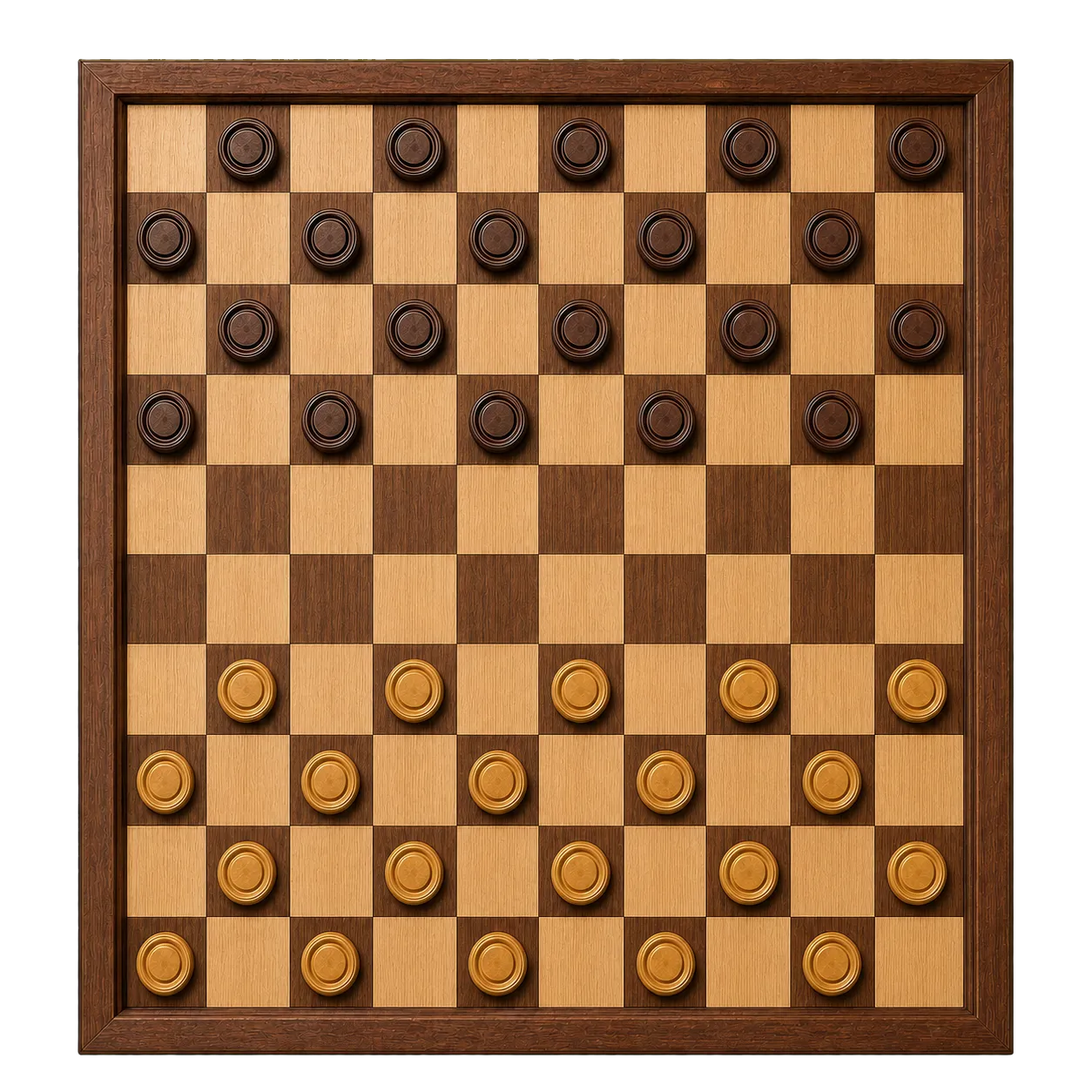
Played on a larger 10×10 checkerboard (100 squares total). Each player starts with 20 pieces placed on the dark squares of the first four rows.
Powerful Kings
Kings in International draughts can move any number of squares diagonally in any direction. This makes them extremely powerful and creates complex tactical situations.
Mandatory Capture
If you can capture an opponent's piece, you must do so. Multiple captures in a single turn are allowed and must be completed. You must choose the sequence that captures the most pieces.
Maximum Strategic Depth
International draughts offers the deepest strategic gameplay of all draughts variants. The larger board and powerful kings create incredibly complex positions.
Official Competition Variant
International draughts is the official variant used in world championships and international tournaments. It's recognized by the World Draughts Federation (FMJD).
European Popularity
Most popular in the Netherlands, France, Belgium, Poland, Russia, and other European countries. The standard competitive variant across the continent.
International Draughts Rules
Learn how to play International Draughts step by step
Initial Setup
Board: International draughts is played on a 10×10 checkerboard (100 squares total). Only the dark squares are used for play.
Starting Position: Each player begins with 20 pieces. Black pieces are placed on the dark squares of the first four rows closest to the player. White (or Red) pieces occupy the dark squares of the four rows on the opposite side.
First Move: The player with the white pieces moves first. In tournament play, colors are often determined by drawing lots.
Basic Movement Rules
Regular Pieces (Men): Regular pieces can only move forward diagonally to an adjacent dark square. They cannot move backward or jump over their own pieces.
King Promotion: When a regular checker reaches the opposite end of the board (the last row), it is immediately promoted to a king. The king is marked by stacking another piece on top or using a special king piece.
King Movement: Kings in International draughts can move any number of squares diagonally in any direction (forward or backward). They can move along the entire diagonal line, making them extremely powerful pieces. This is a key distinguishing feature of International draughts.
Capture Rules (Jumping)
Mandatory Capture: If a player can capture an opponent's piece, they must do so. You cannot choose to make a regular move if a capture is available.
How to Capture: To capture, a piece jumps diagonally over an opponent's piece to an empty square immediately beyond. The captured piece is removed from the board.
Multiple Captures: If after a capture, the same piece can make another capture, it must continue jumping. All captures in a sequence must be completed in a single turn.
King Captures: Kings can capture in any diagonal direction and can jump over multiple pieces in a single move, landing on any empty square beyond the last captured piece. They can capture both forward and backward.
Capture Priority: If multiple capture sequences are available, you must choose the one that captures the most pieces. If two sequences capture the same number, you may choose either. This rule is strictly enforced in International draughts.
Winning the Game
Victory Conditions: A player wins by:
- Capturing all of the opponent's pieces
- Blocking all of the opponent's pieces so they cannot move
- Forcing the opponent into a position where they have no legal moves
Draw: The game ends in a draw if:
- The same position repeats three times (with the same player to move)
- Both players agree to a draw
- Neither player can force a win (rare endgame positions)
- No capture has been made and no king has been created in the last 50 moves (tournament rule for International draughts)
History of International Draughts
From European origins to world championship play
European Origins
International draughts evolved from various European draughts variants in the 18th and 19th centuries. The game developed as players sought a more complex and strategically rich version than the 8×8 variants.
The 10×10 board size was standardized in France and the Netherlands, where the game became extremely popular. The larger board and more pieces created significantly more complex positions and deeper strategic play.
Standardization and Organization
19th Century: International draughts rules were codified in Europe, particularly in France and the Netherlands. The powerful king movement (unlimited diagonal movement) became a defining characteristic.
Key Development: The rule requiring players to choose the capture sequence that takes the most pieces was established, adding another layer of strategic complexity.
Competitive Growth: Draughts clubs and societies were established throughout Europe. The game gained recognition as a serious competitive sport, not just a pastime.
World Championships and Federation
First World Championship: The first official World Championship in International draughts was held in 1885. Since then, world championships have been held regularly, with players from across Europe competing.
World Draughts Federation: The Fédération Mondiale du Jeu de Dames (FMJD) was established to govern International draughts competitions worldwide. The FMJD organizes world championships, continental championships, and maintains official rules.
Notable Champions: Many legendary players have dominated International draughts, including Iser Kuperman, Ton Sijbrands, and Alexander Georgiev. The game has produced some of the strongest draughts players in history.
Modern Status
Today, International draughts remains the premier competitive variant of draughts. It's the official variant used in world championships and is recognized as the most strategically complex form of the game.
The game is extremely popular in the Netherlands, France, Belgium, Poland, Russia, and other European countries. Online platforms have made International draughts more accessible, allowing players worldwide to compete and learn from masters.
International draughts continues to be studied by computer scientists and game theorists due to its complexity. While not yet "solved" like English draughts, it represents one of the most challenging strategy games for both humans and computers.
Where is International Draughts Popular?
Discover the countries and regions where International draughts is played
Primary Countries
Netherlands: International draughts (known as "dammen") is the national game of the Netherlands. It's extremely popular, with thousands of registered players, regular tournaments, and a strong competitive scene. The Netherlands has produced many world champions.
France: Known as "jeu de dames" in France, International draughts is very popular. France has a strong competitive tradition and has hosted many world championships. The game is played in clubs, schools, and online.
Belgium: International draughts is highly popular in Belgium, especially in the Dutch-speaking regions. Belgium has produced world-class players and hosts regular tournaments.
Poland: International draughts is widely played in Poland, with a strong competitive scene. Polish players regularly compete in European and world championships.
Other European Countries
Russia: International draughts (known as "шашки") is very popular in Russia. Russian players have won multiple world championships, and the game is taught in schools and played in clubs throughout the country.
Ukraine: International draughts is popular in Ukraine, with strong players and regular competitions. Ukrainian players have achieved success in world championships.
Latvia, Lithuania, Estonia: The Baltic states have strong International draughts traditions, with active competitive scenes and regular tournaments.
Other European Countries: International draughts is played across Europe, including in Germany, Italy, Spain, and other countries, though with varying levels of organization and popularity.
Cultural Significance
International draughts holds a special place in European culture, particularly in the Netherlands and France. The game is associated with:
- Serious competitive play and world championships
- Intellectual development and strategic thinking
- Community clubs and social gatherings
- School education programs
- Professional players and masters
- Online competitive platforms
Unlike English draughts, which is often seen as a casual family game, International draughts has a reputation as a serious competitive sport. It's recognized for its strategic depth and complexity, attracting players who enjoy challenging intellectual games.
International Draughts Strategy & Tactics
Master the art of International draughts with advanced strategies
Opening Principles
Control the Center: On the larger 10×10 board, controlling central squares is even more important. Central pieces have maximum mobility and can support multiple areas of the board.
Develop All Pieces: With 20 pieces, it's crucial to develop your entire army. Don't leave pieces inactive in the back rows. Create a connected, harmonious position.
Avoid Weak Squares: The larger board means more potential weak squares. Be careful not to create holes in your position that your opponent can exploit.
Piece Coordination: With more pieces on the board, coordination becomes even more critical. Pieces that work together are exponentially stronger.
Middle Game Tactics
King Promotion: Getting kings is absolutely crucial in International draughts. The powerful kings can control large areas of the board and create devastating threats.
Forced Captures: Look for opportunities to force your opponent into disadvantageous captures. The mandatory capture rule can be used tactically to gain material or positional advantages.
Maximum Capture Rule: Always calculate all possible capture sequences. You must choose the one that captures the most pieces, which can sometimes lead to surprising tactical sequences.
King Activity: Once you have kings, use them actively. Kings can control multiple diagonals and create threats from a distance.
Endgame Techniques
King Endings: Endgames with kings are extremely complex in International draughts. Kings can move long distances, creating intricate tactical and strategic problems.
Material Count: Count pieces carefully. Even a one-piece advantage can be decisive with proper technique, especially with kings on the board.
Blocking Techniques: Learn to use your pieces to block opponent pieces, especially preventing promotion to kings.
Time Management: In tournament play, manage your time carefully. The larger board and more pieces mean more possible moves to consider.
Advanced Tactical Patterns
Long-Range Combinations: With powerful kings, combinations can span the entire board. Look for sequences that involve multiple captures across long diagonals.
King Forks: Position kings to threaten multiple opponent pieces simultaneously. The long-range movement makes forks very powerful.
Sacrifice Combinations: Sacrificing material to gain kings or create winning positions is common. Calculate these carefully.
Positional Play: The larger board emphasizes positional understanding. Control of key squares and diagonals becomes crucial.
Improving Your Game
Study Master Games: Review games from world champions. International draughts has a rich literature of master games to study.
Practice Regularly: Play often against strong opponents. The complexity of International draughts means there's always more to learn.
Learn Openings: Study common opening systems. The larger board means more opening theory than in 8×8 variants.
Solve Problems: Practice tactical puzzles. Calculating long capture sequences is essential for strong play.
Use Computer Analysis: Modern computer programs can help analyze positions and identify mistakes. Use them as learning tools.
Other Draughts Variants
Discover different rules and strategies from around the world
🇬🇧 English Draughts
Learn the rules and strategy of English Draughts, played on an 8×8 board with 12 pieces per player.
🇺🇸 American Checkers
Learn the rules and strategy of American Checkers, the most popular variant in the United States.
🇷🇺 Russian Checkers
Discover Russian Checkers with powerful kings that can move any distance diagonally on an 8×8 board.
🇧🇷 Brazilian Draughts
Explore Brazilian Draughts, similar to international draughts, popular in Brazil and South America.
Ready to Play International Draughts?
Join thousands of players and start your draughts journey today
Play International Draughts Free →