Play Turkish Checkers Online
Discover Turkey's traditional strategy game, played along straight lines instead of diagonals. Compete with 16 pieces per player on an 8×8 board, master mandatory captures and powerful flying kings, and explore the rich culture of Turkish Checkers.



What Makes Turkish Checkers Unique?
Discover the features that set this game apart from other draughts variants
Straight-Line Movement
Pieces move forward and sideways instead of diagonally. Every light and dark square on the board is used.
16 Pieces Each
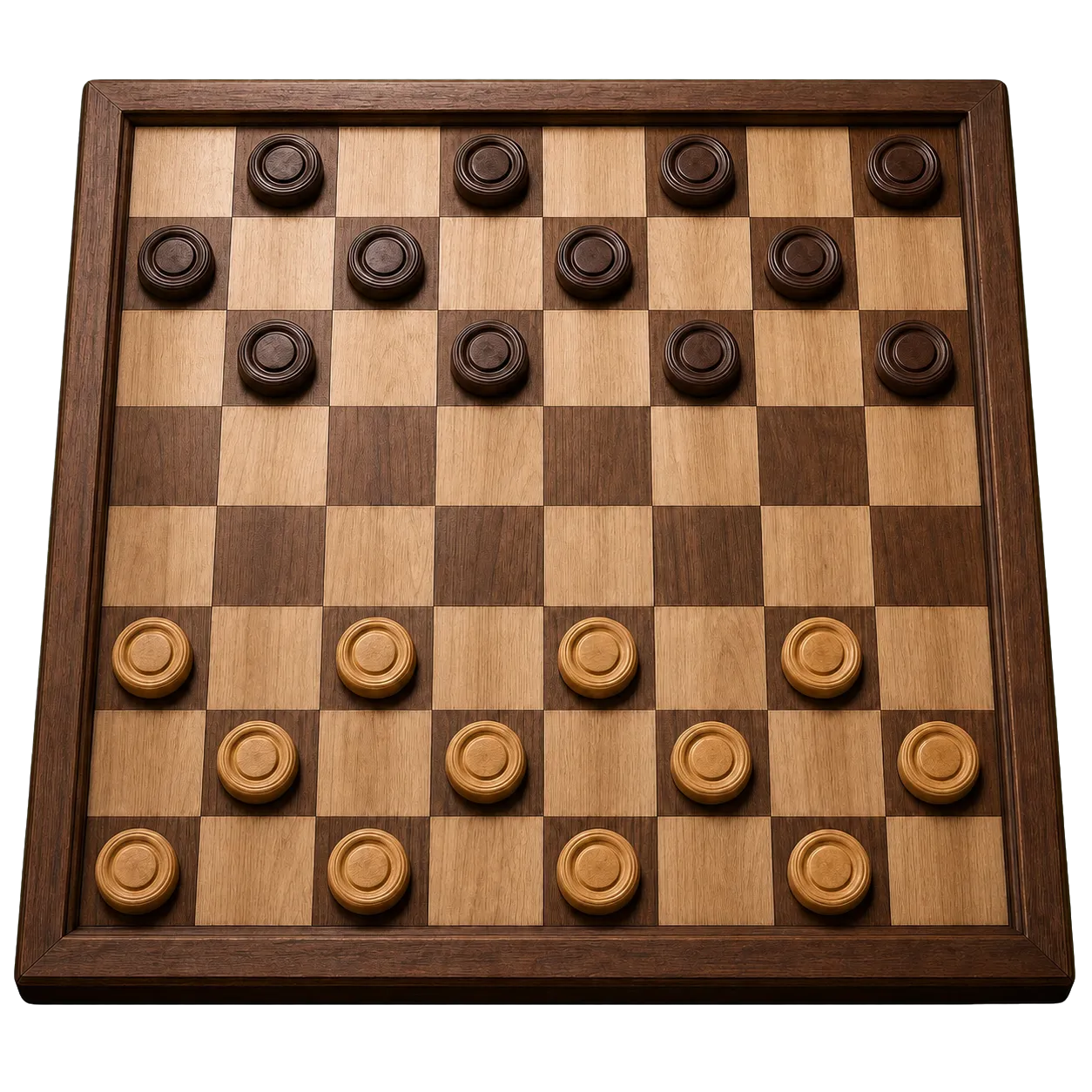
Each player begins with 16 pieces filling the second and third rows. The back row and two central rows remain empty.
Maximum Capture
Capturing is mandatory. When several routes are available, the player must choose one that captures the greatest number of pieces.
Powerful Kings
Kings can travel any clear distance forward, backward, left, or right, capture from range, and turn during multi-captures.
Immediate Removal
Captured pieces are removed during the sequence, opening new paths and enabling long, surprising combinations.
A Living Tradition
Passed down from the Ottoman era, Turkish Checkers remains active in cafés, clubs, online play, and international tournaments.
Turkish Checkers Rules
Learn how to play step by step
Board and Starting Position
Board: Turkish Checkers is played on an 8×8 board with 64 squares. Unlike most checkers variants, every square is used.
Pieces: Each player has 16 pieces. They fill the second and third rows nearest the player, leaving the back row and two middle rows empty.
Goal: Win by capturing all opposing pieces or blocking the opponent so that no legal move remains.
Movement of Men
Quiet move: A man moves one square forward, left, or right. It cannot make a normal move backward and never moves diagonally.
Capture: A man jumps over an adjacent opposing piece into the empty square immediately beyond. Men capture forward and sideways, but not backward.
Promotion: A man reaching the final row becomes a king. If it reaches that row during a capture and another sideways capture is available, it continues as a man; it uses king powers from its next move.
Movement of Kings
Flying movement: A king may travel any number of clear squares forward, backward, left, or right.
Long-range capture: It jumps over an opposing piece in the same row or column and lands on a suitable empty square beyond it.
Multiple capture: A king may turn 90 degrees after a capture, but it may not reverse direction by 180 degrees along the same line.
Immediate removal: Every captured piece is removed before the sequence ends, which can open routes that were previously blocked.
Mandatory Capture and Priority
Capture is mandatory: A player who can capture may not make a quiet move.
Majority rule: If several capture routes exist, a route taking the maximum number of pieces must be chosen. The player may choose freely between routes with equal totals.
No king priority: When a man and a king can capture the same maximum number, either piece may be selected. The number captured matters, not the type of moving piece.
Winning and Drawing
Victory: A player wins by taking all opposing pieces, leaving the opponent without a legal move, or accepting the opponent's resignation.
Draw: The game is drawn when both players have only one piece left. Players may also agree to a draw, and a threefold repetition of the same position is a draw.
History of Turkish Checkers
A tradition stretching from the Ottoman court to modern tournaments
A Golden Age in the Ottoman Era
Turkish Checkers was enjoyed both by the public and around the Ottoman court. It flourished especially during the reign of Sultan Abdülaziz, when leading players were invited to the palace and masters could receive the title of “damacıbaşı,” or chief checkers player.
Games by famous masters such as İbrahim Bey entered the written record. Draughts treatises published in the late nineteenth century preserved classic compositions and expert play for later generations.
Café and Master-Apprentice Culture
For generations, Turkish Checkers was passed on through homes, cafés, and local gathering places. Experienced players taught not only moves and combinations, but also patience, respect, and the etiquette of the game.
This social tradition helped preserve complex compositions, sacrifice patterns, and strategic knowledge as both an oral and written culture.
Modern Organization
The International Turkish Checkers Championship, held in Mustafakemalpaşa since 2000, has played an important role in introducing the game to new audiences. The Turkish Checkers Federation has helped standardize rules and strengthen tournament play.
Turkish Checkers is also represented within the World Draughts Federation, FMJD. Online platforms now let players learn the game and meet opponents from around the world.
Where Is Turkish Checkers Played?
A game tradition extending from Turkey across the Mediterranean and Middle East
Turkey: The Heartland
Turkish Checkers is played in homes, cafés, clubs, and tournaments throughout Turkey. Mustafakemalpaşa in Bursa is one of today's key community centers, known for its long-running international championship.
International Reach
Related forms of the game are played in Greece, Cyprus, Lebanon, Syria, Jordan, Egypt, Kuwait, and neighboring countries. International events bring together players from Turkey, the Balkans, Central Asia, and the Gulf region.
Cultural Significance
- Strategy game: It develops calculation, planning, and the ability to anticipate forced replies.
- Social tradition: It brings players of different ages together around the same board.
- Master-apprentice learning: Openings, compositions, and game etiquette pass from experienced players to newcomers.
- Competitive sport: Local clubs and international championships provide an organized tournament scene.
Turkish Checkers Strategy and Tactics
Core ideas for building stronger positions
Opening Principles
Keep pieces connected: Pieces that support one another are more resilient against forced-capture tactics.
Watch the center: Pieces on central rows and files influence more directions, but advancing too quickly can leave open lanes behind them.
Develop the back row carefully: Emptying it too early may give the opponent a quick promotion route, while leaving it untouched can restrict your own position.
Middle-Game Tactics
Exploit compulsory captures: Calculate which piece your opponent must take and draw it onto a square that enables your longer combination.
Count the entire route: Do not stop at the first jump. The majority rule can make a small sacrifice lead to a much larger material gain.
Control horizontal lanes: Sideways movement and capture create tactical ideas that do not exist in diagonal draughts variants.
Playing with Kings
Open lines: Kings are strongest on clear rows and columns. Plan exchanges that create room for their long-range movement.
Anticipate turns: A king may turn 90 degrees during a capture sequence, but cannot reverse by 180 degrees. Build routes around this restriction.
Choose a safe landing: A king does not always need to land close to the captured piece. Use the available landing squares to prepare the next move.
Improve Your Game
Calculate sequences to the end: Because captured pieces disappear immediately, update the board mentally after every jump.
Review your losses: Reconstruct any missed majority rule or compulsory-capture trap after the game.
Play varied opponents: Regular online games are one of the fastest ways to encounter new openings, sacrifices, and tactical patterns.
Other Checkers Variants
Discover different boards, movement rules, and strategies from around the world
🌍 International Draughts
Explore the world championship variant played on a 10×10 board.
🇷🇺 Russian Checkers
Learn the dynamic 8×8 variant with flying kings and diagonal combinations.
🇧🇷 Brazilian Draughts
Discover the Brazilian game that brings international-style rules to an 8×8 board.
🇬🇧 English Draughts
Explore the classic English game with short-range kings.
Ready to Play Turkish Checkers?
Put the rules into practice, discover new tactics, and start playing for free.
Play Turkish Checkers Free →